What this service is
Continuous Improvement is SFG’s people-centered method for making work visible, removing avoidable friction, clarifying ownership, and establishing a measurable future state before technology is selected.
 USA
USA
C — Map the Process
Continuous Improvement is SFG’s people-centered method for making work visible, removing avoidable friction, clarifying ownership, and establishing a measurable future state before technology is selected.
Executive decision guide
Clearer work, stronger ownership, and less operational drag.
Continuous Improvement is SFG’s people-centered method for making work visible, removing avoidable friction, clarifying ownership, and establishing a measurable future state before technology is selected.
Chief operating officers, transformation leaders, operational executives, service leaders, process owners, and boards sponsoring material performance improvement.
Critical work is slow, inconsistent, difficult to govern, or dependent on workarounds. Leaders may see symptoms in cost, service, risk, and employee effort without a shared view of the end-to-end process or its root causes.
Bring one consequential workflow to a focused executive diagnostic. SFG will clarify the outcome, identify the people and evidence required, and determine whether deeper process discovery is justified.
Discuss this service ↗What the work can include
We define the decision, owners, evidence, controls, and adoption conditions before committing to a solution.
We define the decision, owners, evidence, controls, and adoption conditions before committing to a solution.
We define the decision, owners, evidence, controls, and adoption conditions before committing to a solution.
We define the decision, owners, evidence, controls, and adoption conditions before committing to a solution.
We define the decision, owners, evidence, controls, and adoption conditions before committing to a solution.
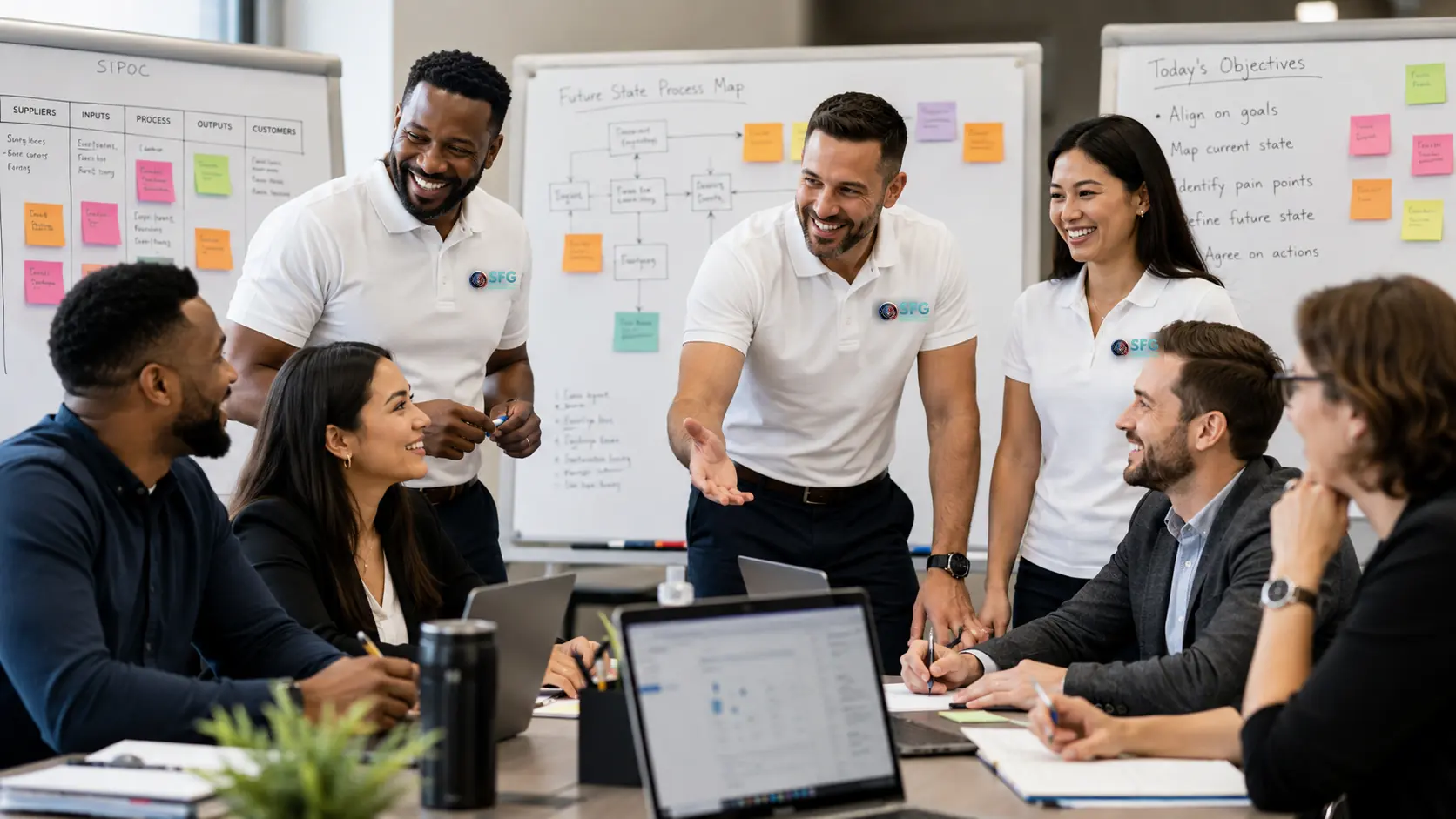
See the work before changing the system.
C / Continuous ImprovementThe SFG CBA Framework
AI is introduced after the process, decisions, information, controls, and people affected are understood. This sequence protects value and prevents technology from scaling avoidable waste.
Clarify the outcome, map the real work, remove friction, and establish ownership.
Govern the information, definitions, measures, access, and decisions the work requires.
Apply the least-complex responsible technology after the foundations are ready.
How engagement begins
Clarify the consequential outcome and decision.
Expose friction, information gaps, and readiness.
Design a bounded intervention with evidence.
Expand only when value, controls, and adoption are visible.
Executive buying questions
Concise answers to the questions leaders commonly need resolved before commissioning this work.
Continuous Improvement determines whether the work should happen, how it should flow, and who owns it. Automation is considered only after unnecessary steps, unclear decisions, weak controls, and information gaps are addressed.
No. SFG applies the level of Lean Six Sigma discipline appropriate to the problem, from a focused workflow diagnostic to an enterprise improvement system.
A focused discovery can usually establish the problem frame, stakeholders, baseline needs, and next decision before a larger implementation is commissioned. Timing depends on process complexity and access to people and evidence.
A practical next step
A focused executive conversation will clarify the outcome, operating constraints, evidence available, and whether this capability is the right place to begin.